
India dominates IT outsourcing for a reason — 1.5 million new engineering graduates every year, a mature services ecosystem, and rates that are 60-70% lower than hiring in the US or Europe. But having a large talent pool also means there are thousands of vendors to choose from, and the quality gap between the best and worst is enormous.
After running Treesha Infotech for over 11 years and delivering 300+ projects across 20+ countries, I've seen both sides. I've watched companies waste six figures on the wrong partner, and I've seen startups scale from zero to millions with the right one. This guide is what I wish every CTO and founder had before making that decision.
In This Article
Why India for IT Outsourcing in 2026?
The numbers speak for themselves. India's IT services industry is projected to cross $300 billion in 2026. But beyond the cost savings, there are structural advantages that make India particularly strong for software development:
- Talent density — India produces more software engineers annually than the US, UK, and Germany combined
- English fluency — India is the world's second-largest English-speaking country, which eliminates the communication barriers common with other offshore destinations
- Timezone advantage — IST (UTC+5:30) allows meaningful overlap with both European and US business hours
- Mature ecosystem — companies like TCS, Infosys, and Wipro built the foundation, but mid-size firms (10-100 people) now deliver the best value for startups and SMBs
- Upwork dominance — Indian freelancers and agencies consistently rank among the top-rated on Upwork, Toptal, and other platforms
The 10-Point Evaluation Checklist
Before you talk to a single vendor, know what you're evaluating them on. Here's the framework we recommend:
1. Technical Expertise (Match Your Stack)
Does the company have proven experience in your technology stack? If you're building a scalable Next.js SaaS product or require an AWS serverless architecture, don't hire a team whose portfolio is entirely basic WordPress sites. Look for depth in your specific frameworks—whether that's Laravel, React, or complex cloud deployments—because a company that claims to do "everything" often masters nothing.
- Check their GitHub or public repositories
- Ask about specific technologies, not just "web development"
- Ensure they understand modern infrastructure and scalability
2. Relevant Industry Experience
A team that has built e-learning platforms before will be 3x faster at building yours than one learning the domain from scratch. Industry experience means they understand your users, compliance requirements, and common pitfalls.
| Industry | What to Look For |
|---|---|
| E-Learning/EdTech | SCORM/xAPI compliance, LMS experience (Moodle, custom), multi-tenant architecture |
| SaaS | Subscription billing, multi-tenancy, usage analytics, API-first architecture |
| E-Commerce | Payment gateway integrations, inventory management, performance at scale |
| Healthcare | HIPAA compliance, data encryption, audit logging |
| FinTech | PCI DSS compliance, real-time processing, regulatory requirements |
3. Communication & Process
This is where most outsourcing relationships fail — not on technical ability, but on communication. Evaluate:
- Response time — do they reply within hours or days during evaluation?
- English quality — not just fluency, but clarity and precision
- Project management tools — Jira, Linear, Asana, or something structured
- Communication channels — Slack/Teams for daily, Zoom for weekly, email for formal
- Reporting cadence — weekly demos, sprint reports, burndown charts
4. Portfolio & Case Studies
Don't just look at screenshots. Dig deeper:
- Visit live URLs — is the product fast, well-designed, and functional?
- Ask for measurable results — "We reduced load time by 60%" is better than "we built a beautiful website"
- Check project scale — have they handled projects similar in size and complexity to yours?
- Look for longevity — long-term client relationships indicate trust and quality
5. Team Structure & Availability
Understand exactly who will work on your project:
- Will you get a dedicated team or shared resources?
- What's the seniority mix? (All juniors = cheaper but slower)
- Is the project manager technical or purely administrative?
- What happens if a key developer leaves mid-project?
6. Client Reviews & Reputation
Third-party reviews are harder to fake than portfolio pages.
- Clutch.co — the gold standard for IT services reviews (verified through client interviews)
- Google Business Profile — check ratings and read the actual reviews
- GoodFirms — another reliable directory
- Upwork/Toptal profiles — if they're on platforms, check their job success score and client feedback
- LinkedIn — see what clients and employees say
7. IP Protection & Legal
Non-negotiable items before you start:
- NDA — signed before you share any project details
- IP assignment clause — all code, designs, and deliverables are yours
- Source code access — code lives in your GitHub/GitLab, not theirs
- MSA (Master Services Agreement) — covers payment terms, liabilities, termination
- Data protection — GDPR compliance if serving European users
8. Pricing Model & Transparency
Understand what you're paying for and how:
| Model | Best For | Risk Level |
|---|---|---|
| Fixed Price | Well-defined projects, clear specs, no scope changes | Low (for client), budget predictable |
| Time & Material (T&M) | Evolving requirements, agile projects, ongoing development | Medium, need active involvement |
| [Dedicated Team](/services/consulting-teams/staff-augmentation) | Long-term engagements (6+ months), continuous development | Low, consistent velocity |
| Retainer | Maintenance, support, periodic feature additions | Low, predictable monthly cost |
9. Trial Project (Paid)
Never commit to a $50,000 engagement without testing the relationship first.
- Start with a small, paid trial task ($500-$2,000)
- Evaluate: code quality, communication, deadline adherence, problem-solving, and crucial workflow compatibility.
- A trial isn't just a test of their code—it's a test of whether your teams can smoothly collaborate day-to-day.
- Any reputable company will welcome a trial — it's a chance to prove themselves
10. Cultural & Timezone Fit
Cultural alignment matters more than people think:
- Work ethic — do they push back on bad ideas, or just say yes to everything?
- Proactivity — do they suggest better approaches, or only do exactly what's asked?
- Accountability — when something goes wrong, do they own it or make excuses?
- Timezone — minimum 3-4 hours daily overlap for real-time collaboration
Outsourcing Models Compared
Not sure whether to hire freelancers, an agency, or build an offshore team? Here's the honest comparison:
| Factor | Freelancer | Small Agency (5-20) | Mid-Size Firm (20-100) | Large Enterprise (100+) |
|---|---|---|---|---|
| Hourly Rate | $15-40 | $25-60 | $40-80 | $80-150 |
| Team Redundancy | None (single point of failure) | Limited | Strong | Very strong |
| Project Management | You manage | Basic PM included | Dedicated PM | Full PMO |
| QA/Testing | Usually none | Manual testing | Dedicated QA team | Automated + manual |
| Best For | Small tasks, bug fixes | MVPs, small projects | Ongoing products, complex apps | Enterprise, regulated industries |
| Risk Level | High | Medium | Low-Medium | Low |
| Communication | Direct, fast | Direct, fast | Structured, reliable | Structured, sometimes slow |
For most startups and SMBs building products in the $10K-$100K range, a mid-size firm (20-100 people) offers the best balance of quality, cost, and reliability. You get dedicated resources, proper processes, and enough depth to handle complex projects — without the overhead and bureaucracy of enterprise firms.
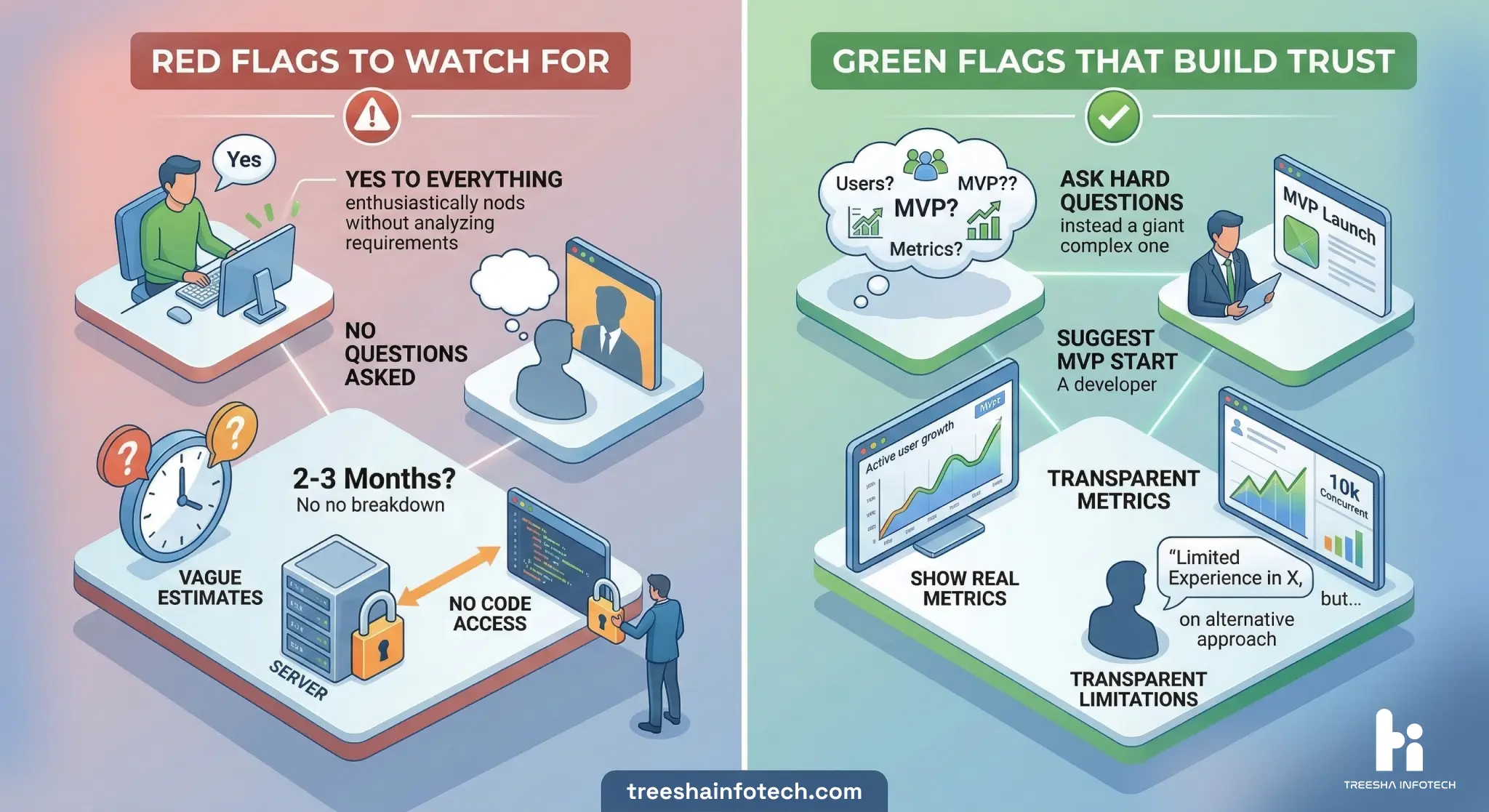
Red Flags to Watch For
After 11 years in this industry, these are the warning signs that almost always predict problems:
- Yes to everything — if they never push back or suggest alternatives, they're not thinking critically about your project
- No questions asked — a good partner asks more questions than you expect before giving an estimate
- Vague estimates — "it'll take 2-3 months" without a breakdown means they haven't thought it through
- No process documentation — if they can't explain their development process, they don't have one
- All junior developers — ultra-low rates usually mean inexperienced teams
- Guaranteed timelines for undefined scope — no honest company promises fixed timelines before understanding requirements
- No code access — if they want to host your code on their servers, walk away
- Unusually fast turnaround promises — quality software takes time; if they promise your SaaS in 2 weeks, they're either lying or building something you won't want
Green Flags That Build Trust
On the flip side, these signals indicate a partner worth investing in:
- They ask hard questions during the discovery phase — about your users, business model, and success metrics
- They suggest a smaller scope to start — a good partner will recommend an MVP over a full build
- They show real metrics from past projects — not just "we built it" but "it handles 10,000 concurrent users"
- Transparent about limitations — "we don't have deep experience in X, but here's how we'd approach it"
- Existing long-term clients — clients who've stayed 2+ years indicate trust and quality
- Clear handoff process — documentation, knowledge transfer, and code that doesn't depend on them
The Evaluation Process (Step by Step)
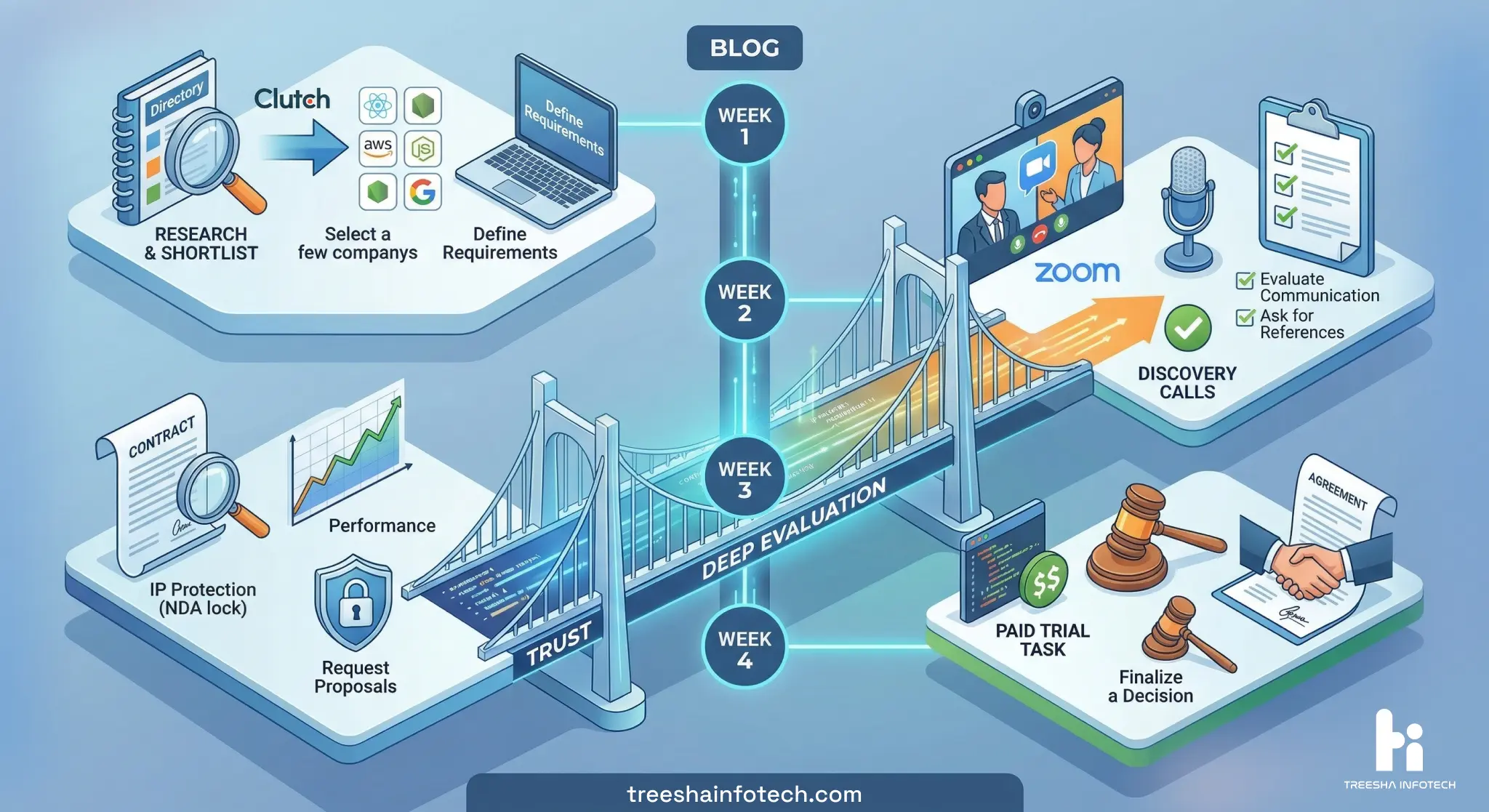
Here's the exact process we recommend for finding and validating an outsourcing partner:
Week 1: Research & Shortlist
- Define your requirements (technology, timeline, budget range)
- Research on Clutch, GoodFirms, Upwork, and Google
- Create a shortlist of 5-8 companies
- Send initial inquiries with a brief project description
Week 2: Discovery Calls
- Schedule 30-45 minute calls with your top 4-5 companies
- Evaluate: communication quality, technical understanding, relevant experience
- Ask for case studies, references, and proposed team structure
- Narrow down to 2-3 finalists
Week 3: Deep Evaluation
- Request detailed proposals and estimates from finalists
- Contact 2 past clients from each company (ask Clutch reviewers directly)
- Review their code quality (ask for a sample repo or open-source contribution)
- Discuss engagement terms, IP protection, and payment structure
Week 4: Trial & Decision
- Issue a small paid trial task to your top 1-2 choices
- Evaluate: code quality, communication, deadline adherence, feedback handling
- Make your decision based on trial results, not just proposals
- Sign contracts and begin onboarding
What to Expect After You Sign
A good outsourcing partner will run a structured kickoff:
- Week 1 — access setup, requirement deep-dive, architecture planning
- Week 2 — sprint planning, first development sprint begins
- Week 3-4 — first demo of working features, feedback cycle starts
- Ongoing — bi-weekly demos, weekly progress reports, daily standups during overlap hours
The first 30 days are the most important. If communication, quality, and velocity feel right during this period, you've probably found the right partner. If not, it rarely improves — better to cut early and try your second choice.
How Treesha Infotech Approaches Partnerships
Full disclosure — this article is written by the CEO of an outsourcing company, so take this section with that context. But here's what we believe differentiates a good partnership:
- We start with a discovery call, not a sales pitch. We need to understand your business before proposing anything
- Every project gets a dedicated team — not shared resources bouncing between clients
- Code lives in your repository — GitHub or GitLab, your account, your ownership
- Weekly demos are non-negotiable — you see working software every week, not just status reports
- We say no when something doesn't make sense — if your timeline is unrealistic or your approach has flaws, we'll tell you
- Post-launch support is included — we don't disappear after deployment
With 300+ projects delivered, a 5.0 rating on Upwork across 196+ engagements, and clients across 20+ countries, we've refined this approach over 11 years. But more importantly, we've learned that the best client relationships are built on honesty, not sales promises.
Bottom Line
Choosing an outsourcing partner is a high-stakes decision. Get it right, and you gain a reliable extension of your team at a fraction of the cost. Get it wrong, and you lose months of time and tens of thousands of dollars.
> The cheat code? Don't optimize for the lowest price. Optimize for the team that asks the best questions, communicates clearly, delivers quality work in a trial, and has the reviews to prove they've done it before.
Frequently Asked Questions
Why is India the most popular destination for IT outsourcing?
How much does it cost to hire an IT outsourcing partner in India?
What are the biggest risks of outsourcing to India?
How do I protect my intellectual property when outsourcing?
Should I choose a freelancer or an agency for outsourcing?
What is the ideal team structure for an outsourced project?
How long does it take to find and onboard an outsourcing partner?
What engagement model should I choose — fixed price, time & material, or dedicated team?
How do I evaluate the quality of an outsourcing partner's previous work?
What timezone overlap do I need with my Indian outsourcing partner?
Ready to start your project?
Tell us about your requirements and we'll get back with a clear plan within 24 hours. No sales pitch — just an honest conversation.

Founded Treesha Infotech in 2014 with a mission to deliver world-class IT solutions from India. With 300+ projects across 20+ countries, Raju leads client strategy, business development, and long-term partnerships. A recognized Moodle specialist, he personally oversees every major engagement to ensure it exceeds expectations.