
The AI landscape is shifting fast. While chatbots dominated the conversation in 2023, 2025 is all about AI agents — autonomous systems that can reason, plan, and execute multi-step workflows without constant human oversight. For businesses looking to automate beyond simple rule-based triggers, agents represent the next major leap in operational efficiency.
What Makes AI Agents Different?
Traditional chatbots follow scripts. They respond to prompts with pre-defined answers or simple completions. AI agents, on the other hand, can break down complex goals into steps, use tools (APIs, databases, code execution), and adapt their approach based on intermediate results.
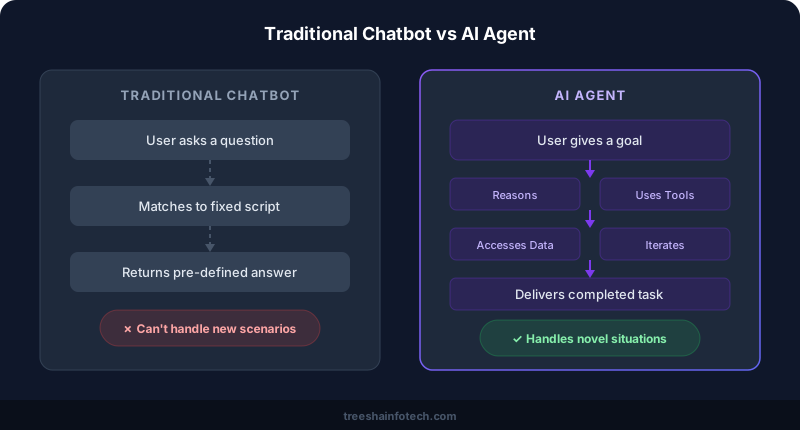
Think of the difference between asking someone to answer a question versus asking them to complete a project. Agents handle the latter — they research, draft, iterate, and deliver.
A Concrete Example
A traditional chatbot can answer "What's our refund policy?" An AI agent can process a refund request end-to-end — check the order status, verify eligibility, initiate the refund in your payment system, update the CRM, and send the customer a confirmation email. All without a human touching it.
Real-World Use Cases
At Treesha Infotech, we've built AI agent systems for several clients. The use cases that deliver the most value include:
- Customer support automation — agents that resolve tickets end-to-end, handling refunds, account changes, and troubleshooting without human intervention
- Data pipeline agents — systems that clean, transform, and load data from multiple sources, flagging anomalies for human review
- Sales qualification agents — AI that qualifies inbound leads, drafts personalized outreach emails, and schedules follow-up calls
- Document processing — agents that extract data from invoices, contracts, and forms, then push it into your accounting or CRM system
- Content generation — AI that drafts blog posts, social media content, and email campaigns based on your brand guidelines
- Code review agents — automated pull request reviews that check for bugs, security issues, and style violations
The common thread? These are all repetitive, well-defined tasks that eat hours of human time every week. Automating them with agents frees your team to focus on work that actually requires human judgment.
ROI by Use Case
| Use Case | Time Saved | Typical ROI Period |
|---|---|---|
| Customer Support | 60-80% of ticket handling | 2-3 months |
| Lead Qualification | 70% of manual screening | 1-2 months |
| Document Processing | 90% of data entry time | 1 month |
| Report Generation | 85% of manual compilation | 2 months |
| Email Follow-ups | 75% of drafting time | 1 month |
The Technology Stack
Modern AI agents are built on Large Language Models (LLMs) like GPT-4, Claude, and Gemini, combined with orchestration frameworks like LangChain, CrewAI, and AutoGen. These frameworks manage the complexity of tool calls, memory, and multi-step reasoning.
Key Components
- LLM backbone — GPT-4o, Claude 3.5, or Gemini for reasoning and language understanding, powered by AI & ML development expertise
- Orchestration layer — LangChain or LangGraph for managing agent workflows and tool calls
- Vector database — Pinecone, Weaviate, or pgvector for RAG-based knowledge retrieval
- Tool integrations — API integrations connecting to your CRM, email, database, and business systems
- Monitoring — observability to track agent decisions, costs, and accuracy over time
RAG (Retrieval-Augmented Generation) is often part of the stack, allowing agents to ground their responses in your company's actual data rather than relying solely on training data. This means your agent can answer questions about your specific products, policies, and processes — not just generic information.
What It Costs (And What It Saves)
The investment for an AI agent project varies widely based on complexity.
| Project Type | Cost Range | Timeline |
|---|---|---|
| Simple chatbot / single workflow | $5,000 - $15,000 | 2-4 weeks |
| Multi-step agent with integrations | $15,000 - $30,000 | 4-8 weeks |
| Multi-agent system (enterprise) | $30,000 - $50,000 | 8-12 weeks |
| Ongoing API costs (monthly) | $50 - $500 | Ongoing |
But the ROI is often compelling. If an agent saves 20 hours of human work per week, that's roughly $2,000-$4,000/month in labor costs for most businesses. The agent pays for itself within 2-4 months and keeps saving after that.
Getting Started
The best way to start is with a focused pilot. Pick one workflow that's repetitive, well-defined, and high-volume. Build an agent to handle it, measure the results, and expand from there. We typically see 60-80% time savings on the workflows we automate.
The 3 Criteria for a Good AI Agent Candidate
- Repetitive — the task follows a mostly predictable pattern
- Well-defined — clear inputs, outputs, and success criteria
- Manageable errors — the cost of an occasional mistake is low, or the agent can escalate to a human when uncertain
What About Hallucination?
This is the most common concern we hear. Modern agent architectures address this through guardrails (output validation), RAG (grounding in real data), tool use (checking facts against databases), and human-in-the-loop escalation for uncertain decisions. A well-built agent knows when it doesn't know — and asks for help.
If you're considering AI agents for your business, we'd love to help. Schedule a discovery call and we'll map out the opportunities together. We'll identify which workflows have the highest automation potential and build a proof-of-concept to validate the approach before committing to a full build.
Frequently Asked Questions
What is an AI agent?
How much does it cost to build an AI agent?
How long does it take to build an AI agent?
Can AI agents replace human employees?
Ready to start your project?
Tell us about your requirements and we'll get back with a clear plan within 24 hours. No sales pitch — just an honest conversation.

Co-founded Treesha Infotech and leads all technology decisions across the company. Full-stack architect with deep expertise in Laravel, Next.js, AI integrations, cloud infrastructure, and SaaS platform development. Ritesh drives engineering standards, code quality, and product innovation across every project the team delivers.